
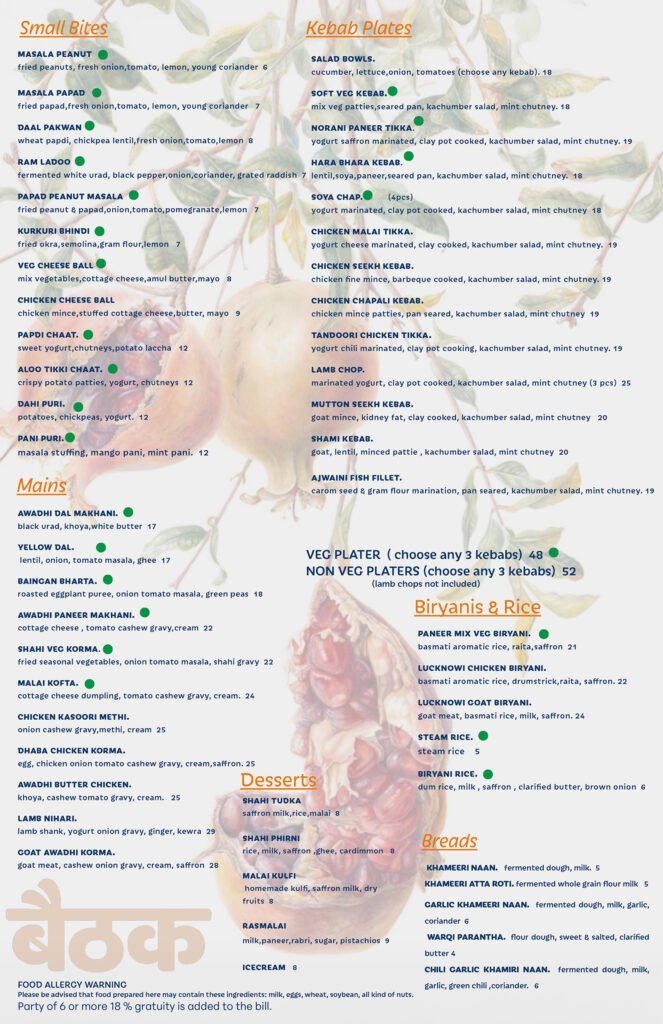
A good Indian menu should feel inviting, not confusing. At Baithak in Dublin, CA, the menu is built to help guests enjoy the experience slowly, with dishes that bring warmth, comfort, and a sense of occasion. If you are looking at an Indian restaurant menu for the first time, the easiest way to read it is by thinking in layers: start small, build flavor, add something warm, and finish with balance. 🌿
This guide is meant to help guests understand the menu without repeating the full menu page. It supports the main Baithak dining experience by showing how the different sections work together.
Start with small plates
Small plates are often the best place to begin because they set the tone for the meal. These dishes are usually lighter, shareable, and full of personality. They can wake up your appetite without making the meal feel too heavy too soon.
At Baithak, this part of the menu is ideal if you want a relaxed start with the table. Small plates also make sense for guests who like to share and taste a few different flavors before moving on to the main dishes. If you are new to Indian food, this is an easy way to explore the menu with confidence.
Look at the curry section as the center of the meal
Curries usually form the heart of an Indian meal. They bring depth, spice, and comfort to the table. Some curries are rich and indulgent, while others feel lighter and more aromatic. That variety is what makes the category so useful.
When reading an Indian menu, think of curries as the dish that defines the pace of the meal. If you want something comforting, choose a curry that feels warm and full. If you want something a little lighter, look for a dish with more balance and less richness. Either way, curries are where the menu often becomes most memorable.
Understand breads as the comfort piece
Breads are one of the easiest parts of the menu to enjoy, but they also play an important role. They help carry sauces, balance spice, and make the meal feel complete. Warm bread can turn a simple curry into a more satisfying plate.
At Baithak, breads are a natural part of the experience because they make the meal feel more personal and more interactive. Many guests enjoy choosing a bread based on the curry they ordered, and that pairing is often what makes the meal feel complete.
Use rice to bring the plate together
Rice is the balance point of the meal. It softens stronger flavors and helps create a more grounded plate. If bread adds comfort, rice adds structure. If a curry feels bold, rice helps it settle into something smooth and satisfying.
This is why rice is such an important part of an Indian restaurant menu. It is not just a side. It helps shape the whole meal and gives guests another way to enjoy the flavors on the table.
How to build a balanced order
A simple way to read the menu is to think in this order:
start with a small plate, choose one curry or grilled dish, add bread or rice, and finish with something that makes the meal feel complete. That formula works well whether you are dining alone, with family, or with a group.
If you want to keep the meal light, choose a starter and a curry with bread. If you want a fuller experience, add rice and share a few dishes across the table. The menu is flexible enough to support both styles.